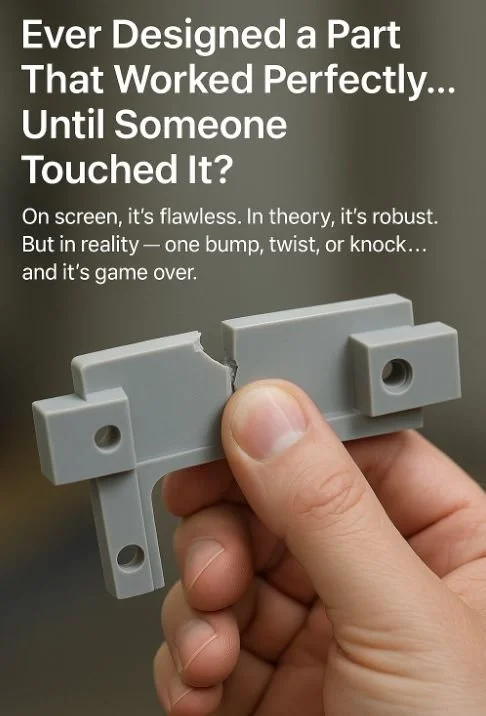
Ever Designed a Part That Worked Perfectly...
"Ever Designed a Part That Worked Perfectly... Until Someone Touched It?"
On screen, it's flawless.
In theory, it’s robust.
But in reality — one bump, twist, or knock… and it’s game over.
That’s the difference between designing for function and designing for use.
I’ve seen it (and done it):
-Tabs that snap under real-world loads
-Enclosures that don’t seal once tolerances stack
-Fasteners placed in fantasy locations, not reachable ones
It’s a lesson every designer learns eventually:
Real users aren’t gentle, careful, or working under ideal lab conditions.
They drop, twist, yank, over-tighten, under-tighten, and generally test your design in ways no spec sheet ever predicted.
That’s why iteration matters.
Testing, tweaking, failing fast — and refining until it’s right.
Not perfect in CAD. Not perfect on paper.
But perfect in use.
Good design isn’t just CAD-deep.
It’s not about making it look good.
It’s about making it survive contact with reality.