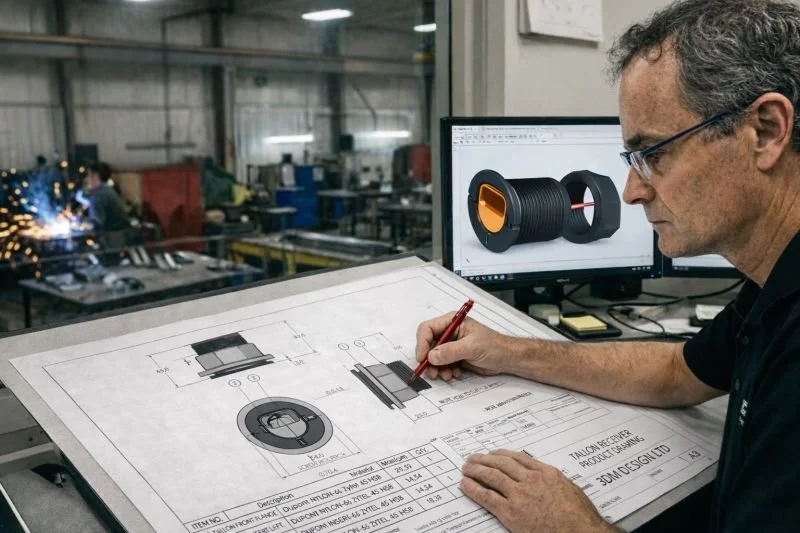
“A good drawing doesn’t describe the part… it defines the outcome.”
I still see it all the time — clean 3D models, but drawings that leave too much open to interpretation.
And that’s where things go wrong.
Because in manufacturing:
Assumptions = variation
Variation = cost
Cost = frustration
A drawing should answer every real-world question before it gets asked:
Where does it locate?
What actually matters dimensionally?
What can move vs what must not?
What finish is functionally required (not just “nice to have”)?
If your fabricator has to call you… the drawing isn’t finished.
The best drawings I’ve seen have a few things in common:
Clear datums and logical dimensioning strategy
Tolerances applied where they matter (not blanket overkill)
Manufacturing intent baked in (welds, finishes, assembly logic)
Zero ambiguity
It’s not about making a “pretty” drawing.
It’s about removing risk.
Because once it hits the workshop floor, your drawing is the product.
If you’ve ever had a job come back wrong — chances are the issue started here.